The HighRegard platform
One business. All its visibility data. One ranked queue of things to do.
Connect Google Ads, Search Console and Analytics read-only, and import your Google Maps geo-grid scans. The application finds what matters, explains why, ranks what to do, blocks what cannot be trusted yet, records the decision and measures what happened next.
- Website Score
- Google Maps geo-grid
- AI visibility
- Google Business Profile
- Reviews and reputation
- Authority and citations
- Paid search
- Organic search
- Unified search
- Tracking health
- Opportunity feed
- Decision journal
- Data quality
- Twenty free tools
The product film
A verdict, a queue, and the evidence behind every item.
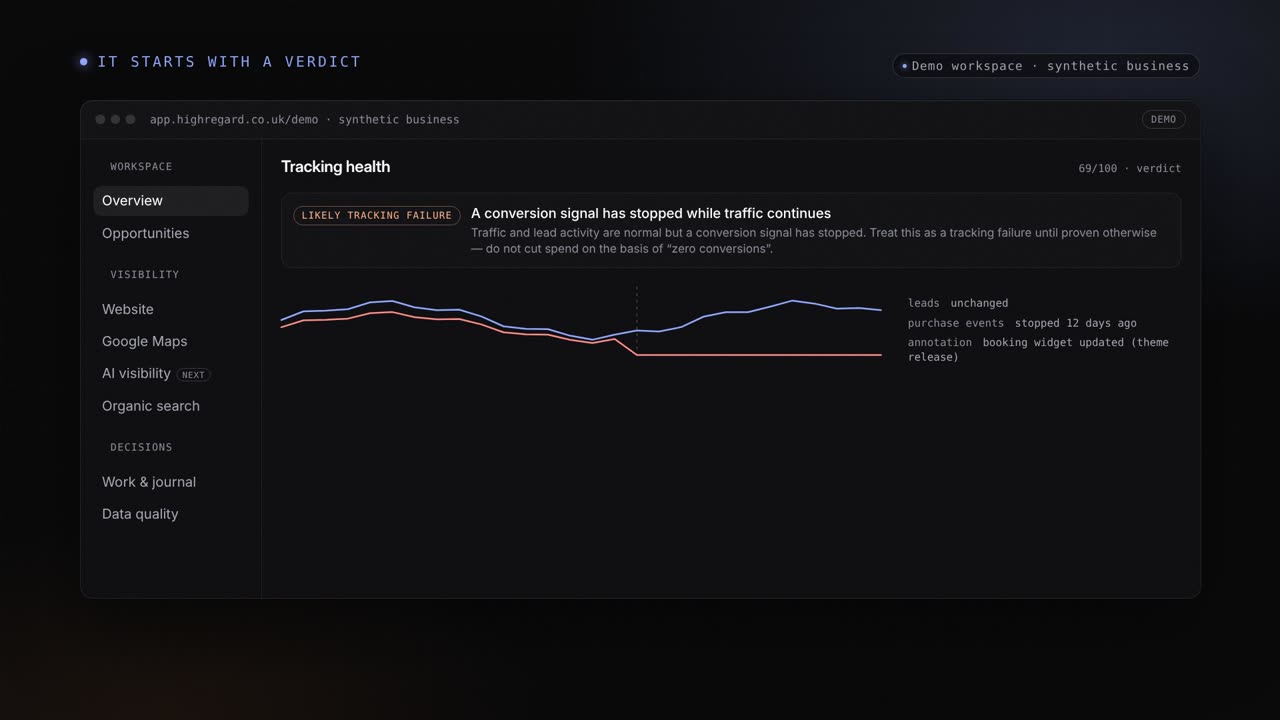
Two minutes on the demo workspace: a conversion signal that stopped, the actions blocked until it is repaired, the next three opportunities with their evidence, and where the AI visibility module joins the same queue when it ships.
Every figure is the demo workspace’s own. The AI layer is shown as forthcoming, because it is.
Transcript
Four sources, connected read-only: Google Ads, Search Console, Analytics, and your Google Maps geo-grid scans. One workspace. One question: what should we do next?
It starts with a verdict. Traffic and leads are normal, but a conversion signal stopped twelve days ago, the day the booking widget was updated. Likely tracking failure. So before anything else, the budget and bidding actions that depend on that signal are blocked. Not ranked lower. Blocked.
Tracking is repaired. The verdict clears, the estimates recompute, and the queue moves on.
Next: three hundred and eighty-seven pounds on fourteen search terms that never convert. Then a page that gets two hundred and sixteen sessions and almost no enquiries. Then the map. Number one at the door, absent across sixty-four per cent of the area for blood tests.
Every item carries the same three things: the evidence it was measured from, the fix, and how you’ll verify it worked. Observed, estimated and judgement are kept apart, so you can disagree with the right part.
And the AI layer is coming into the same queue. A fixed bank of customer prompts, run against named assistants on a schedule. Named rate. Which competitors appear. Which sources they’re cited from. Why. Then an opportunity: strengthen the service entity and the sources that corroborate it. Today that’s measured in the audit and the free live test. In the workspace, it’s next.
Accept, assign, or dismiss, with a reason. Next month asks: did it work?
Live now, and what comes next
Four sources and three modules live today. Three modules still to come.
The same list appears on the home page and is updated on the day a module ships, so what is sold and what is promised never blur.
- Google Adscampaigns, search terms, schedule, geography, creative
- Search Consolequeries, pages, striking distance, decay, cannibalisation
- Analytics 4landing pages by outcome, lead and conversion counts
- Google Maps geo-gridsrank at every grid point, coverage, paired change
- Tracking healthverdicts that block actions built on a broken signal
- Opportunity queueimpact × confidence ÷ effort, every item explained
- WordPress pluginthe workspace inside wp-admin, read-only, with checks on the site’s own pages
- AI visibilitymention rate and sources across assistants
- Reputationreviews against the competitors that outrank you
- Authority and citationsreferring domains and directory consistency
Until then these are measured by hand in every audit and, instantly, by the free AI Visibility Test, AI Readiness Checker and Domain Authority Checker.
Nothing on the right is sold as software today. Each module is added to this list, and to the changelog, on the day it is live in the demo.
Real output
This is the application, not a picture of one.
Everything below is generated by the engine from the demo workspace (synthetic business, 28-day window ending 2026-09-11). Open the demo and you will find the same figures.
Overview. The questions an owner asks first, answered from the connected sources, with the tracking verdict on top when it matters.
Unified search. Paid and organic for the same query, side by side, with a plain reading of what to do about it.
Google Maps. The geo-grid for “laser hair removal bradford”: rank 1 at the door, top-3 across 20% of the area, weakest to the east. Scan of 2026-09-10; change is paired against the previous scan on the same grid.
Maps, in numbers. Top-3 and top-10 coverage over 75 valid points, all terms pooled; absent points count as depth + 1 in the average rank. The Maps score is 0.6 × top-3 + 0.4 × top-10.
Opportunity feed. Ranked, typed and gated. Budget and bidding actions stay visible but blocked while the conversion signal is unreliable — 4 of 27 in this window.
Recorded from the application
Twelve seconds in the workspace, and three screens from it.
Screen recordings of the demo workspace as it runs, not mock-ups: the synthetic business, frozen at 2026-09-11, with its demo banner cropped from the top of each frame and nothing else changed.
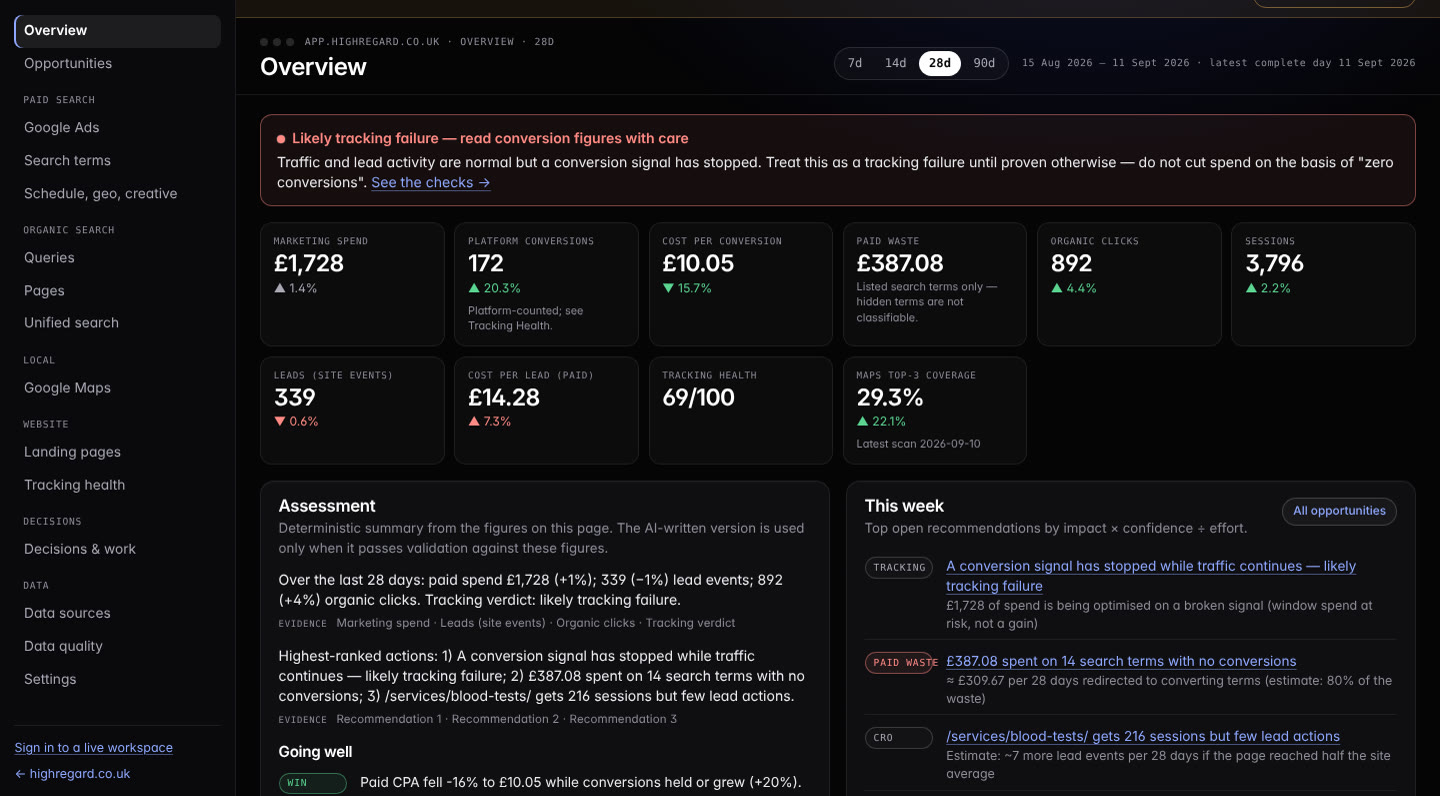
Overview. The questions an owner asks first, answered from the connected sources, with the tracking verdict on top.
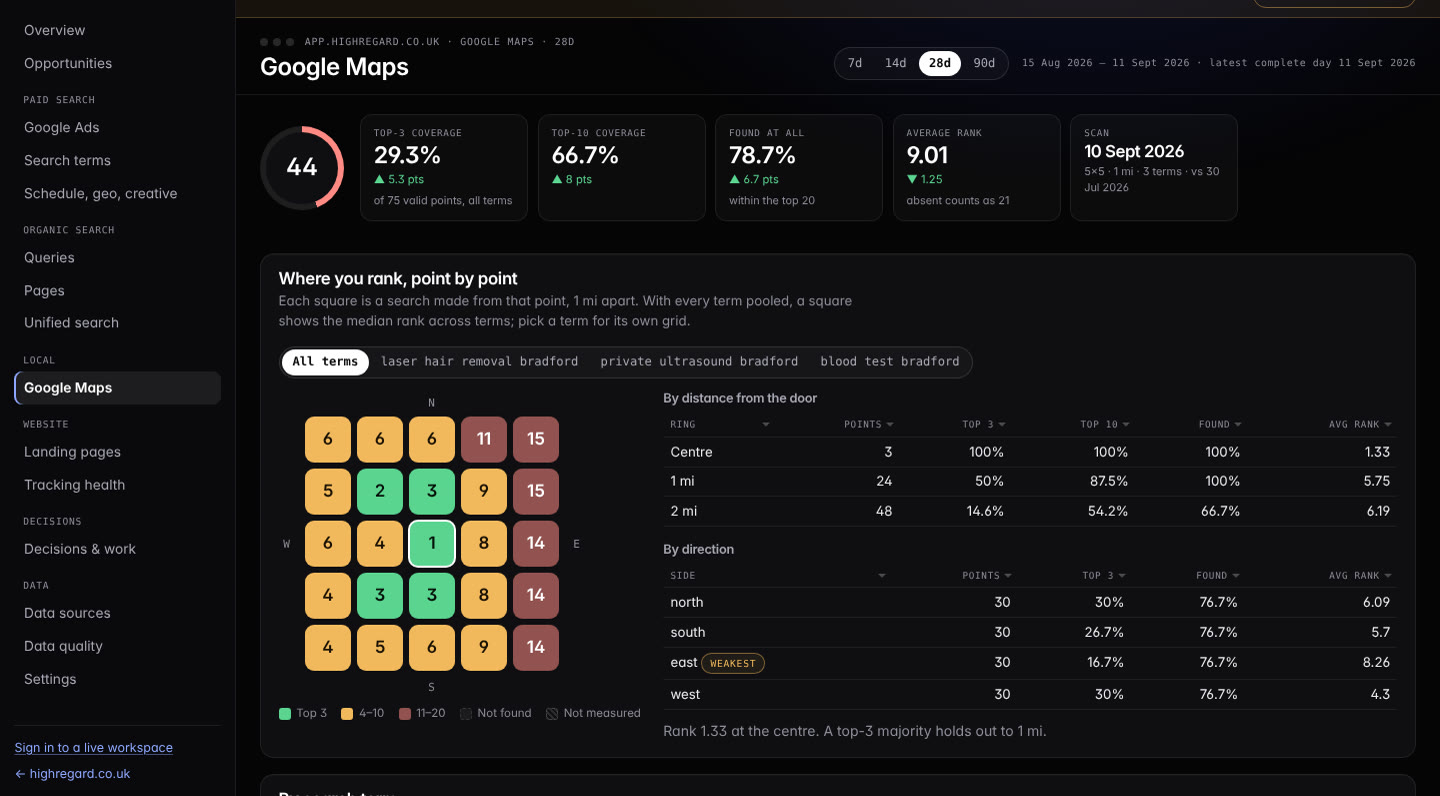
Google Maps. The geo-grid module: rank at every point, coverage by distance and direction, paired change since the last scan.
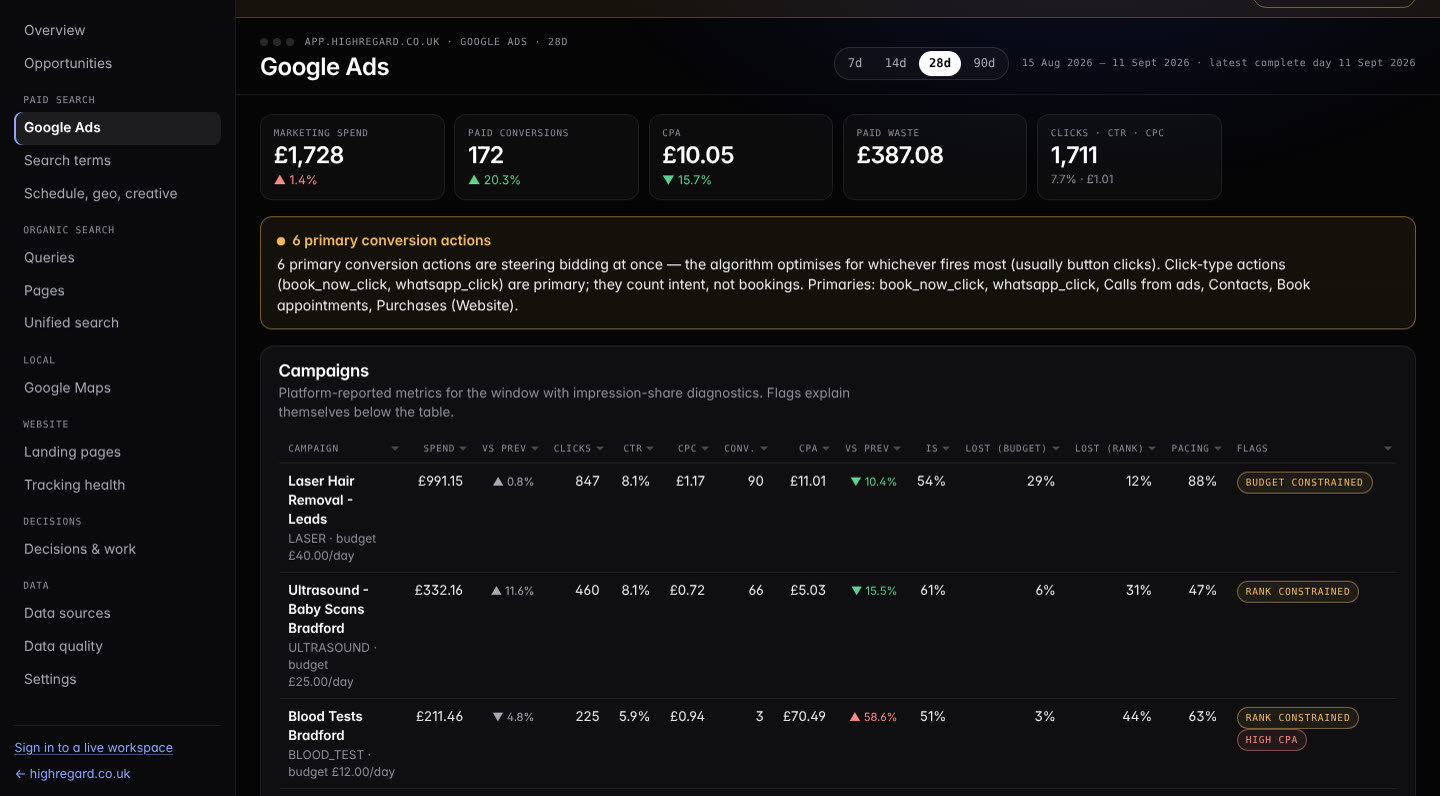
Google Ads. Spend, conversions and the search terms behind them, read against the tracking verdict before any budget advice.
The same workspace on your own business
The free snapshot is a person looking at your website first; platform access comes with the Local and Growth plans. Twenty minutes with the founder covers which is right.
Or go straight to a product: Free website review, Free · Signature Websites, £749 · Website Revenue Audit, £295 · Repair Sprint, £795 · Monthly plans, from £495/mo · Authority Transformation, £7,495
One issue, followed through
From a number that looks wrong to a decision that is recorded.
Follow the top-ranked item in the demo workspace’s current window through the real screens. The figures are the demo’s synthetic data; the workflow is the shipped one.


01Observe
Lead activity continues while a conversion signal has stopped
Traffic and lead activity are normal but a conversion signal has stopped. Treat this as a tracking failure until proven otherwise — do not cut spend on the basis of "zero conversions". Read from the connected sources for the 28-day window ending 2026-09-11: marketing spend £1,728, leads 339, tracking health 69/100.
Overview, recorded from the demo workspace. Synthetic business, frozen snapshot. 02Evidence
Why the application believes it
The tracking verdict shows which signal stopped, which kept going, and the score behind it (69/100). Each line opens to the source it was read from, so a person can check it before anyone acts.
Google Ads module, recorded from the demo workspace: spend and conversions read against the verdict. 03Recommend
A conversion signal has stopped while traffic continues — likely tracking failure
£1,728 of spend is being optimised on a broken signal (window spend at risk, not a gain). Ranked by impact, confidence (90%) and effort (low), and marked as a risk rather than a gain, because fixing tracking does not earn money by itself. 4 of 27 actions stay blocked until it is fixed.
Google Maps module, recorded from the demo workspace: one of the modules whose actions wait behind the tracking fix. 04Decide
Accepted, assigned, and measured next window
The decision is recorded with a reason and an owner. The next window compares against the expectation that was written down, so “did it work?” has a number in front of it.
DecisionAcceptOwnerDeveloperExpectedConversion signal restoredRe-checkNext 28-day windowDrawn, not recorded: the decision record as the workspace keeps it.
How it thinks
Observation to outcome, with the decision recorded in between.
Most analytics answers “what happened?”. The application is built around the next three questions: what should we do, what did we decide, and did it work.
- ObserveFacts from each source, reconciled against provider totals.
- RecommendRanked by impact × confidence ÷ effort, with the estimate labelled as one.
- GateActions that depend on broken tracking are blocked, not merely ranked lower.
- DecideAccept, assign, experiment or dismiss — always with a reason.
- WorkOwner, due date, status, linked to the recommendation that caused it.
- MeasureThe next window compares against the expectation that was recorded.
- LearnThe journal is the record that lets you ask “did it work?” with the numbers in front of you.
Rules the engine keeps
Deterministic first. Estimates labelled. Unmeasured never scored.
The footer of every application page carries that sentence. These are the engineering rules that earn it.
The AI assessment references named values; the application inserts the figures and rejects any text that adds, scales or re-units a number.
Pounds saved, conversions gained and organic clicks earned are shown as separate totals. Where an estimate is valued in money the assumption is on the item.
Every recommendation separates what was measured from what was projected from what we advise, so you can disagree with the right part.
If a conversion signal has stopped, budget and bidding actions wait until it is fixed. The estimate is recomputed on the next sync.
Google Ads actions are written for the campaign’s actual bidding strategy. Manual bid adjustments are never prescribed to a Smart Bidding campaign.
A check that has not run says “not yet evaluated”. A source that is not connected says so. Nothing missing is ever shown as healthy.
Modules
Every page of the workspace, and its state.
Search first, then the local layer: Google Maps geo-grids are in the workspace now. The AI, reputation and authority layers the rest of this site measures are joining next; the changelog records each on the day it is live.
Overview
Spend, conversions, leads, organic clicks and tracking health with period-over-period change, and an assessment that never types a number itself.
Opportunity feed
Every finding ranked by impact × confidence ÷ effort, classified as observed, estimated or judgement, with prerequisites that block actions built on broken data.
Paid search
Campaigns, search terms, schedule, geography and creative, with recommendations written for the campaign’s actual bidding strategy.
Organic search
Queries and pages from Search Console: striking distance, click-through gaps, decay, cannibalisation and content gaps.
Unified search
The same query seen from paid and organic at once, so you can see what you are paying for that you could earn.
Website and tracking
Landing pages by outcome, and a tracking-health verdict that tells you when a conversion signal stopped before you cut spend on a false zero.
Decisions and work
Accept, assign, experiment or dismiss with a reason. The journal is what lets next month ask “did it work?”.
Data sources and quality
Freshness against each provider’s lag, reconciliation checks, and “not yet evaluated” shown as exactly that, never as healthy.
Google Maps geo-grid
Street-level Maps visibility from the HighRegard GridTracker: rank at every grid point, coverage by distance and direction, paired change since the last scan, and findings in the same queue as paid and organic.
AI visibility
Mention rate and share of voice across AI assistants for your customer prompts, with the sources they cite.
Reputation and authority
Reviews, citations and referring domains against the local competitors that outrank you.
Dated record of what has shipped: the changelog.
Who gets a workspace
The application comes with the work, not instead of it.
Every workspace has a person behind its recommendations while the engine matures. Software-only pricing is deliberately not offered yet.
| What you buy | Application access | What that means |
|---|---|---|
| Free tools and the live demo | No workspace | Instant, anonymous results. The demo workspace runs on synthetic data and needs no sign-in. |
| Website Revenue Snapshot (free) | No workspace | Three findings delivered by email. |
| Website Revenue Audit — £295 | Read-only workspace for 30 days | Your findings, evidence and priorities in the application alongside the written report. |
| Repair Sprint — £795 | Workspace for 90 days | Findings, the implementation record and before/after verification, so you can see what changed and why. |
| HighRegard Local — £495/month | Full workspace, ongoing | Search Console, Analytics and Google Ads connected read-only; the opportunity queue, decisions and monthly report live here. |
| HighRegard Growth — £795/month | Full workspace + AI and competitor modules | Everything in Local plus the AI visibility module (next): the Growth plan’s monthly prompt bank inside the workspace — named rate, cited sources and description accuracy, with the competitors named beside you; measured by hand until it ships. |
| Authority Transformation — £7,495 | Full workspace + bespoke implementation | The workspace is set up during the eight weeks and stays live through the 90-day monitoring period. |
Full prices on the pricing page. Read-only Google access, encrypted tokens and deletion on disconnect are described in the privacy notice.
Questions
Common questions about the platform
Is the demo real software or a mock-up?
Real software. The demo workspace runs the same engine as a live workspace on a synthetic business generated to exercise the analysis. Every page on it is labelled as synthetic, and nothing on it is a real clinic.
Does the AI write the numbers?
No. The figures come from the deterministic layer. The AI-written assessment can only reference named values; the application inserts the figures itself, then validates the text and falls back to a rules-based summary if anything does not reconcile.
What does the application do with my Google accounts?
Read-only access to Google Ads, Search Console and Analytics 4 through Google sign-in, with each connection token stored encrypted. It never changes a bid, a budget or a page. Disconnecting a source removes the token.
Can I buy the software on its own?
Not yet. Workspaces come with the audit, the Sprint, the monthly plans and the Transformation, so every recommendation has a person behind it while the engine matures. Software-only pricing will be published here when it exists.
What is coming next?
Business Profile intelligence, AI visibility (next: the Growth plan’s monthly prompt bank inside the workspace — named rate, cited sources and description accuracy, with the competitors named beside you; measured by hand until it ships), reviews and authority — the local and AI layers that the rest of the site already measures — inside the same workspace, beside the Google Maps geo-grid module that is live now. The changelog lists each one on the day it ships.
See it on synthetic data now, or on your own.
The demo needs no sign-in. Your own workspace comes with the Website Revenue Audit, the Sprint or a monthly plan.
Rather talk? Twenty minutes with the founder, UK time slots: you leave with a clear view of what to do first, whether or not you buy anything.
Every way to work with HighRegard
- Free website reviewFreethree findings from your site, two working days
- Signature Websites£749a new, tailored website to a written scope, including VAT
- Website Revenue Audit£295the full report in three working days
- Repair Sprint£795audit plus up to twelve fixes done for you
- Monthly plansfrom £495/moLocal or Growth: measured, fixed, retested each month
- Authority Transformation£7,495eight weeks, founder-led, by application